Likes
The 2025 Guangdong-Hong Kong-Macao Symposium on Innovation and Application of Digital Intelligence in Education was held at the Shipai campus of South China Normal University on November 14. The hosting of the meeting demonstrated SCNU has attached great importance to empowering teacher education and serving education in the Greater Bay Area through educational AI.
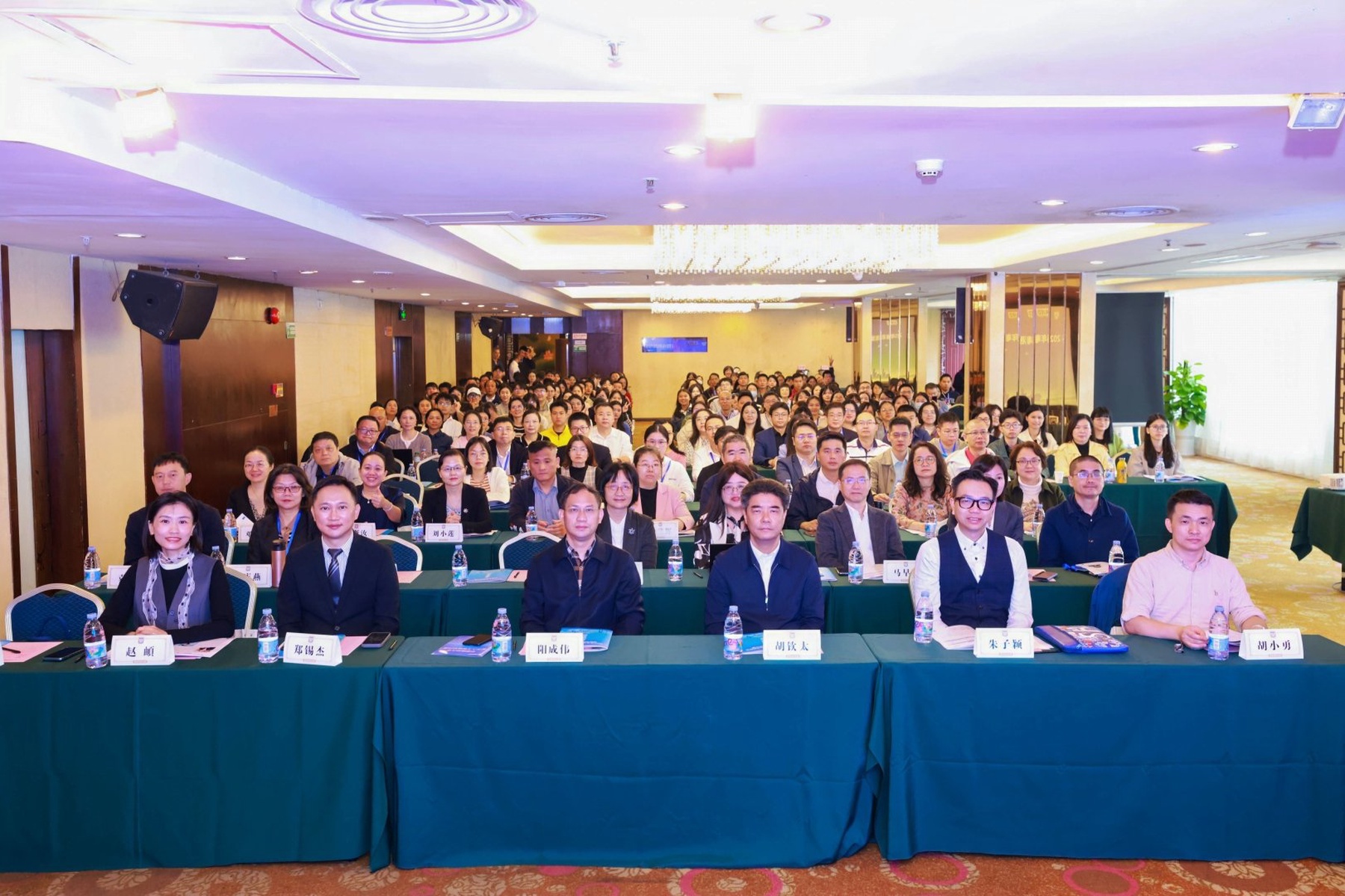
A group photo of participants.
Yang Chengwei, vice president of SCNU, pointed out that SCNU has been rooted in South China for more than 90 years and taken serving the major national strategy as its mission. It has also taken forward-looking initiatives such as setting up the first research Institute of Educational Artificial Intelligence in China, focusing on empowering teacher education and education in the Greater Bay Area with AI, he added.

Yang Chengwei, vice president of SCNU, delivers a speech.
Professor of Guangdong University of Technology Hu Qingtai, a national high-level leading Talent, delivered a keynote report on issues concerning the deep integration of AI and education. He conducted an in-depth analysis of issues such as system development and implementation, and the multi-dimensional understanding of deep integration.
Zheng Xijie, director of the Division of Curriculum Development and Assessment of the Macao Education and Youth Development Bureau, delivered a keynote speech on development and opportunities in the era of AI in Macao. He pointed out that the Bureau has carried out a "Smart Teaching Pilot" and deepened Guangdong-Macao cooperation.
In his report “If They had AI”, Chu Tsz Wing, principal of St. Hilary's Primary School in Hong Kong, emphasized that AI might not only provide academic support and personalized tutorship, but could also impair students' thinking abilities. Schools must hold firm to their fundamental mission of moral education, and cautiously designed application scenarios to ensure technology truly serves learning, and guides students to develop critical thinking skills and learning motivation in the era of AI, he said.

Hu Qingtai (left), Zheng Xijie (middle) and Chu Tsz Wing deliver keynote speeches.
Hu Xiaoyong, executive vice dean of SCNU's Institute of Artificial Intelligence in Education, gave a keynote speech entitled "Questions as a Bridge, Human-Machine Collaboration: Building a New Paradigm for Intelligent Classroom Teaching and Research". Hu systematically elaborated on the new paradigm of "wenke" (questioning-based class), and also introduced the WISE classroom research frame and the AIED human-machine collaboration teaching and research method, which are both originally developed by the "Educational AI Research and Innovation Team" under the Humanities and Social Sciences of Guangdong Provincial Universities.

Hu Xiaoyong shares his views.
To facilitate the exchange of practical experience and insights on AI empowering the innovative development of basic education in the Greater Bay Area, the symposium also organized observation and experience activities of educational AI application scenarios. Experts attending the symposium conducted a round-table session discussing regional examples of innovative cases of AI empowered teachers' development.

Experts take part in round-table discussions.
Co-hosted by South China Normal University and the Guangdong-Hong Kong-Macao Greater Bay Area Teachers' Federation, the event gathered over 300 participants, including officials from educational departments, leaders, experts and scholars, as well as distinguished teacher representatives from basic education sectors across the Greater Bay Area.
Source from SCNU News Center
Translated by Zhong Yiting, Xie Shaochai, Tang Ying
Proofread by Edwin Baak
Edited by Li Jianru
What to read next: