Likes
A groundbreaking pedagogical innovation developed by Professor Zhang Weiguang and Professor Fan Jun's research team at the School of Chemistry in South China Normal University has been featured in Journal of Chemical Education, the premier international forum for chemistry education research published by the American Chemical Society.
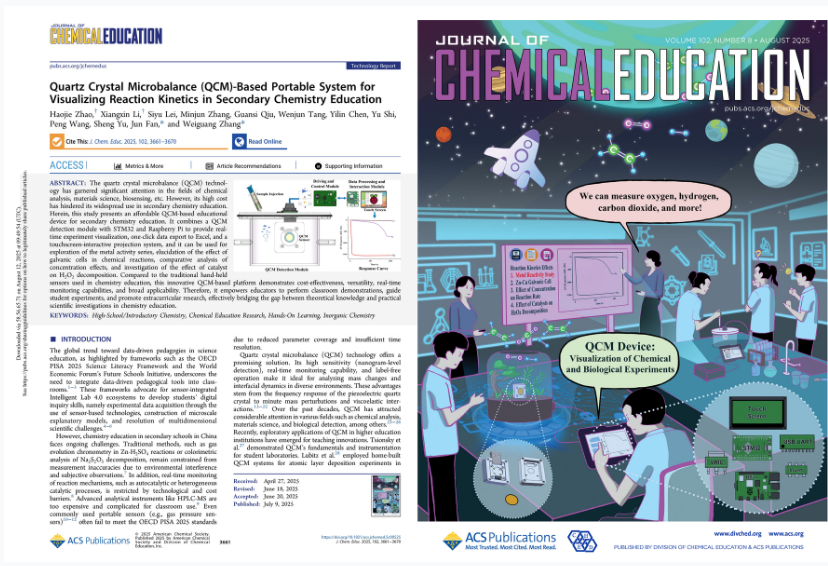
Their cover article, entitled "Quartz Crystal Microbalance (QCM)-Based Portable System for Visualizing Reaction Kinetics in Secondary Chemistry Education", presents an innovative, low-cost, portable, and paradigm-shifting educational tool that redefines STEM experimental pedagogy. This work was highly praised by the reviewers as "The work is technically impressive, educationally relevant, and addresses a real gap in STEM pedagogy by making advanced analytical methods accessible at the pre-university level". Notably, it was selected as the supplementary cover article for the journal issue.

By virtue of the deep integration of a high-sensitive QCM with open-source hardware including STM32 microcontrollers and Raspberry Pi, this as-developed portable teaching device achieves core functionalities such as real-time visualization of reaction kinetics data, one-click data export, and interactive projection. It systematically addresses the long-standing bottlenecks in traditional experimental teaching, particularly the disconnection between abstract theoretical concepts and hands-on operational experiences. It transforms intangible chemical kinetics principles into tangible learning experiences anchored in real-time, quantifiable data, thereby establishing a seamless link between theoretical instruction and practical laboratory operations.
Its low-cost and scalable design not only offers a cost-effective, curriculum-aligned tool for schools in resource-limited regions, but also fosters a student-centered, modern inquiry-based learning approach through its innovative technical features. Combined with an open-source framework and supporting teacher training programs, it establishes a replicable educational model that significantly enhances the global potential for data-driven science education.
Notably, Journal of Chemical Education, founded in 1924, is the flagship SSCI- and SCI-indexed journal in global chemistry education research and is widely recognized as one of the most authoritative and influential publications in the international chemistry community. According to Web of Science statistics, over the past decade (2015–2024), publications from corresponding authors based in Chinese mainland accounted for only about 5% of the total articles published in the journal.
Our university is steadily deepening the integration of scientific research and education innovation, striving to build interdisciplinary platforms for fostering students' creative capabilities and promoting the efficient transformation of cutting-edge research outcomes into foundational educational resources. The commercialized products of the breakthrough, "QCM Teaching Kit", have already been implemented in chemistry instruction at several middle schools, and also donated to Shanwei Haifeng Experimental Middle School, one of our partner schools in Guangdong.

SCNU presents portable "QCM Teaching Kit" to partner school, supporting STEM education outreach.
This achievement was collaboratively developed by interdisciplinary teams consisting of graduate and undergraduate students from chemistry, electronic engineering, education, and other fields. It serves as a model practice of the concept of "scientific research feeding back into teaching and technology empowering middle school classrooms".

Inside view of the portable "QCM Teaching Kit".

Hands-on learning: middle school students utilize QCM in sci-tech competition.
The relevant work has been supported by the National Natural Science Foundation of China, the Science & Technology Project of Qingyuan (Guangdong, China), and the undergraduate student research training program of South China Normal University and the Ministry of Education.
Link to the paper:
https://url.scnu.edu.cn/record/view/index.html?key=8f1cf7f421cbfa15e91c1b677c8d020b
Source from the School of Chemistry
Translated by Zhao Haojie, Zhang Weiguang, Fan Jun
Proofread by Edwin Baak
Edited by Li Jianru
What to read next: